
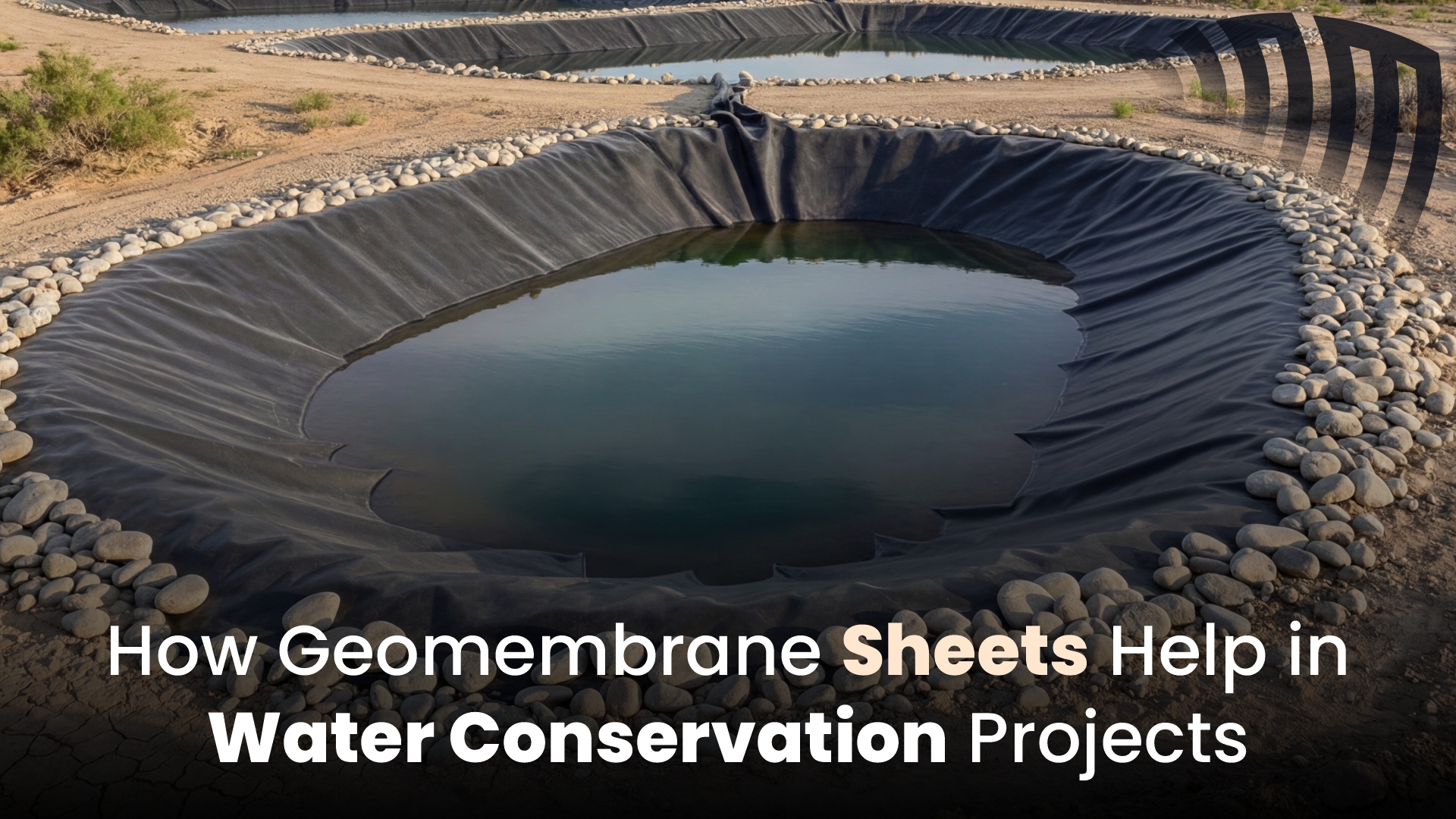
How Geomembrane Sheets Contribute to Water Conservation Efforts:
The lack of adequate water resources ranks among the most critical issues for communities on every continent. Growing populations and shifting climate patterns raise the importance of effective water management practices. Among technological approaches that have been developed to help address this, geomembrane sheets have become a cornerstone in infrastructure related to water conservation. These synthetic barriers are commonly used to prevent water loss, protect water quality, and facilitate sustainable water resource management for a range of applications.
Understanding Geoembrane Technology :
Geomembranes are impermeable synthetic membranes that are manufactured and intended to control fluid migration in engineered systems. Manufactured from polymeric materials including high-density polyethylene, low-density polyethylene, polyvinyl chloride, along with other specialty compounds, the sheets make particularly effective barriers against water seepage and contaminations. Their flexibility, durability, and resistance to environmental degradation make them invaluable for long-term water conservation applications.
The effectiveness of geomembranes comes from their extremely low permeability rates, usually less than one billionth of a centimeter per second. This great impermeability maintains water in the appropriate locus without seepage through surrounding soil or unnecessary evaporation. Modern manufacturing processes have improved these materials to resist ultraviolet radiation to whitestand ultraviolet radiation, chemical exposure, temperature fluctuation, and mechanical stress, extending their functional lifespan to several decades.
Application in Agriculture and Water Management :
In the sphere of agriculture, water conservation plays an important role since 70 percent of global water resources are used. In this regard, the benefit encompasses the capability of geomembrane sheets to address the concern through the use of diverse applications for water conservation. Specifically, the use of geomembrane sheets for lining the irrigation canal emerges as the more forceful means for water conservation. In the natural condition, the water seeping through the canal bed amounts to the loss of up to half the water.
The farm ponds or agricultural reservoirs lined with geomembrane materials have a constant water table throughout the growing season. The water is collected during periods of rainfall and irrigation. This ensures a secure source of water during periods of drought. The geomembrane ensures that this water does not leak into the ground during its excessive presence. This allows farmers to distribute it during farms as needed.
instead according to the crops it requires rather than losing it to natural drainage patterns. Also, efficiency in irrigation through dripping will be enabled by using a barrier of subsidence that allows water to flow towards the roots, achieving this target that minimizes. This reduces evaporative losses and ensures that moisture is available where the plants need it most, thus reducing total water consumed, while increasing or maintaining high yields.
Municipal and industrial water storage :
Municipalities and industrial facilities need reliable water storage to smooth out the fluctuations in supply and for emergency reserves. Geomembrane-lined reservoirs can guarantee safety for communities in storing water with minimal loss due to ground absorption. These installations have been from small community water tanks to massive municipal reservoirs serving hundreds of thousands of residents.
The tightness of geomembranes becomes particularly valuable in regions with porous geological formations where conventional reservoirs would drain out quickly. These synthetic liners create artificial barriers that allow storage in locations that are unsuitable for Qatar, expanding the geographic possibilities for water conservation infrastructure.
Industrial operations employ geomembrane-lined setting ponds and process water storage facilities in the recycling and reusing of water in manufacturing processes. This type of closed-loop system minimizes freshwater withdrawals from natural systems and prevents contaminated water from reaching soil and groundwater systems. The mining industries to food processing industries gain this twin advantage of conservation and environmental protection.
Groundwater Recharge and Aquifer Management:
Managed aquifer recharge schemes use geomembranes in the management of infiltration rates and the prevention of groundwater pollution through controlled groundwater recharging. Infiltration basins featuring the specialized product called Geoembrane facilitate the controlled percolation of treated water to recharge the groundwater table and filter out potential impurities within the water.
Most of these systems employ a composite system in which Geoembranes are used with sand, stone, filters, and soil filters in the purification of water before its downward percolation occurs. The synthetic rope prevents groundwater recharge from spreading haphazardly over large areas. Instead, purified water percolates in specific areas where its quality control and monitoring are done with precision. This way, water resources are well utilized by each aquifer without loss through extensive areas of evaporation and unfruitful water absorption.
Preventing Contamination and Protecting Quality :
Water conservation extends beyond quantity management to include quality preservation. Geomembers create protective barriers that prevent pollutants from reaching stored water supplies. When used in conjunction with water treatment facilities, settling ponds,and purification systems, these isolated while clean water stays protected.
For example, in landfills, there are protective capabilities that are exhibited by geomembranes in preventing water table contamination by leachate. Though a primarily environmental conservation strategy, it indirectly supports water conservation by ensuring water purity in groundwater resources that would otherwise be unusable.
Economic and Environmental Advantages :
The long - term cost effectiveness of geomembrane installations strengthens their role in sustainable water management. While initial installations require investment, the durability and minimal maintenance requirements of quality geomembranes result in decades of reliable services. This longevity translates to alternative dealing methods that frequent repairs or replacement.
Environmental benefits extend to reduced energy consumption in water transportation and treatment. By preventing water loss near points of use, geomembranes decrease the need for pumping water across long distances or treating additional supplies to compensate for seepage losses. This efficiency reduces the carbon footprint associated with water management infrastructure.
Conclusion :
In short, geomembrane sheets have proved to be an important and versatile piece of technology in ensuring efficient and effective water conservancy strategies in our times. This is due to its efficiency in ensuring zero seepage, while simultaneously conserving and storing water across different environments and hostile weather conditions, thus making an extremely significant contribution to the resolution and solution of water scarcity across the globe due to climatic uncertainties and increased water demands as the years pass by.